


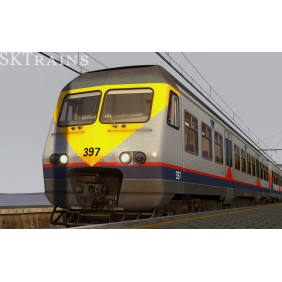
SKTRAINS AM/MS 96
The class 96 (MS96 in Dutch, AM96 in French) is an electric multiple unit constructed in 1996[2] for the National Railway Company of Belgium.
They incorporate features from the DSB IC3 trainsets in order to enable passage from one set coach to another. When two or more units are coupled together in a single train, the entire front door folds away to give a wide passage, and the rubber diaphragms at the ends form a flush aerodynamic seal.
 Security policy
Secure payment via mollie
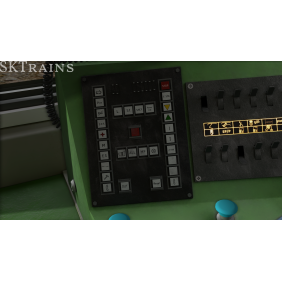
Features
- Realistic driving
- TBL1 +
- TBL
- Dead-Man Feature
- Imposed speed
- Realistic headlights and lantern system
- Realistic sounds
- Compliant markings and signage
- Autostart (CTRL+Z)
- GSM-R
- PIS (passenger information display system)
Customers who bought this product also bought:


SKTRAINS AM80 NEW LOOK (Vol2)
The 03 series (or AM 80) EMU, more often called Break, are triple railcars of the SNCB.
They can run at a maximum speed of 160 km/h, are single-voltage (3000 V) and have a good acceleration and deceleration capacity thanks to their greater power than the previous series.
The AM 80 were given the nickname "Break", partly because their design was radically different from what the SNCB had known until then.


SKTRAINS HVM4
SNCB's M4 coaches are UIC coaches produced in the late 1970s.
The M4 series was ordered together with the multiple units of series 03 (AM-MS 80 / 82 / 83) to meet the needs of the future IC-IR plan of 1984 and the major electrification of the network.


SKTRAINS HVI11
The I11 coaches are modern UIC-Z coaches of the SNCB. They are suitable for speeds up to 200 km/h. Air-conditioned, they offer good comfort conditions with an interior noise level of only 65 dB at 200 km/h.
SKTRAINS AM80 (Bordeaux &...
The 03 series (or AM 80) EMU, more often called Break, are triple railcars of the SNCB.
They can run at a maximum speed of 160 km/h, are single-voltage (3000 V) and have a good acceleration and deceleration capacity thanks to their greater power than the previous series.
The AM 80 were given the nickname "Break", partly because their design was radically different from what the SNCB had known until then.


SKTRAINS AM/MS 86
The 900 series is a series of EMU (two coaches) of the SNCB; they are more commonly called Sprinter (pronounced sprintèrre) or AM 86 after the year of the beginning of construction: from 1986 to 1991. It is characterized by its typical front wall which has the shape of a diving mask (which led to the nickname AM Cousteau). These railcars have a low mass; thus, in conditions of reduced adhesion, the braking and traction performances are strongly degraded.

